Integration of SSDLC into Project Development Process: Risks Assessment and Threat Modeling, stages 1 & 2 from 5
Executive summary
This article documents an ongoing SSDLC integration effort, focusing on practical trade-offs between engineering, management, and business constraints. SSDLC here is treated not only as a technical practice, but as an organizational and business decision.
Over the past week, I integrated a secure software development lifecycle (SSDLC) into our development process. The framework consists of five stages, and this week I completed Stage 1 (risk assessment) and Stage 2 (threat modeling), and began the security design review.
This publication covers the details of integrating SSDLC, focusing on the first two stages.
Business context
SSDLC competes with delivery speed and product priorities. The decision to adopt SSDLC is fundamentally a trade-off between risk tolerance and delivery velocity.
Back in 2023, I highlighted the importance of integrating SSDLC into the development process. Since then, demand has grown even further. Over the past eight years, implementing security requirements in software has evolved from a "nice-to-have" into a "must-have" capability.
Industry reports shown only banks, PaaS providers, and large enterprises can consistently afford full SSDLC implementation. Mid-range businesses can adopt it partially, while smaller companies often recognize the need but lack the budget.
The cost. Salesforce's case study shows 3 months of pure team training, up to 30% time-to-market increase, ROI return back after 12 months. For a small team like ours, we expect up to 100% increase in time-to-market in the first 2 months, up to 20% increase in time-to-market afterwards.
In our case my origin estimates still looks within expectations, but threat modelling stage and design review stage shown significant increase in invested man-hours. Both metrics still fits in estimates from Salesforce case study adopted to a project of our size and domain.
Talents on worldwide market. Ballpark estimate.
| Level | Capability | % of engineers |
|---|---|---|
| Aware | Know what STRIDE / SSDLC is | ~20–30% |
| Intermediate | Can participate in threat modeling | ~10–15% |
| Advanced | Can independently model threats | ~5–10% |
| Expert | Can embed SSDLC into org/process | ~2–5% |
| Architect-level | Can scale SSDLC across org | ~1–3% |
Secure software development overview
The secure software development lifecycle (SSDLC) is the industry's response to the growing number of cyberattacks. While it does not guarantee protection against vulnerabilities or exploitation by malicious actors, it significantly reduces risk and improves cost predictability.
The cost of fixing a vulnerability increases exponentially over time: approximately $100 at the design stage, $1,000 during development, and $10,000 in production. SSDLC shifts issue detection to earlier stages ("shift-left"), helping businesses avoid costly incidents.
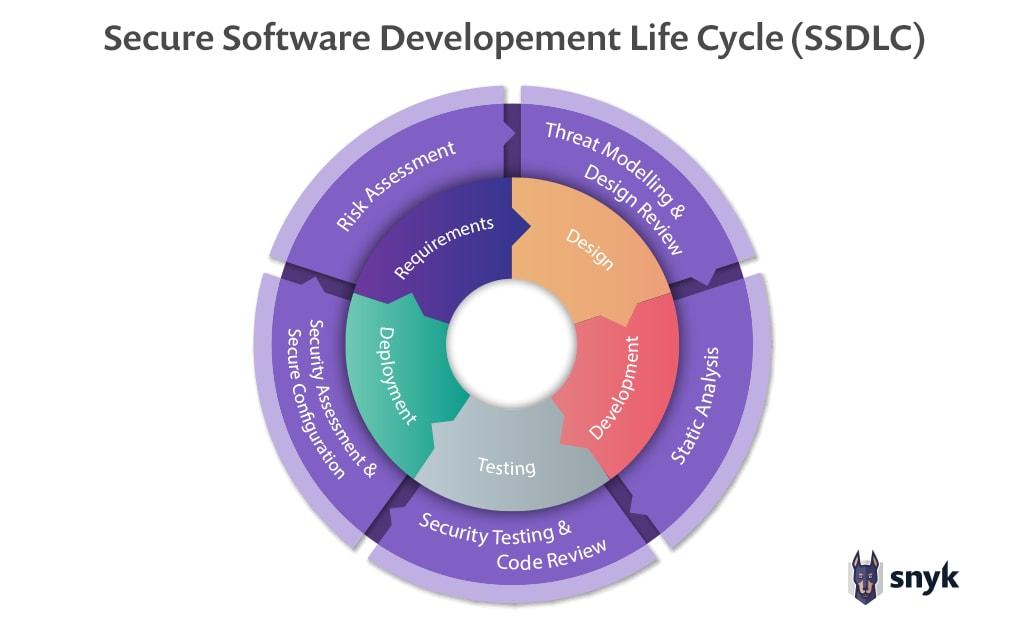
SSDLC typically consists of five stages:
- Risk assessment
- Threat modeling
- Security design review
- Static code analysis and security scanning
- Penetration testing
Risks assessment
The primary goal of risk assessment was not documentation, but decision-making:
- what to fix now
- what to fix later
- what to postpone
The intent behind this stage is go through software requirements and identify potential security risks -- what could goes wrong.
The result of this stage is a document which summarise discovered
threats in format:
- Requirement
- Asset
- Threat
- Attack vector
- Impact / Likelihood / Risk
- Controls
Starting from basic Threat → Risk → Mitigation it evolves further to something like this:

The table above should became the central artifact used across
engineering and management discussions.
- Owner → responsibility
- Priority → planning
- Tracking → control of execution
A simplified "Threat → Risk → Mitigation" model looks minimal
necessary and sufficient, but it would not pass mature enterprise
level security audit:
- there is no link to real hacker attacks
- there is not clear statement of the cause
- there is no way to validate it
Threat modeling
Threat modeling is the next stage in SSDLC, based on gathered requirements and evaluated risks. If risk assessment answers the question “what can go wrong”, then threat modeling answers “how it could realistically happen in the system”.
The primary objective of this stage is not documentation, but validation and execution: to ensure that identified risks are technically plausible, to model realistic attack scenarios, and to define concrete security controls at the architectural level.
Objectives
- Validate that risks are technically plausible
- Identify realistic attack scenarios
- Define architecture-level security controls
- Ensure traceability from risks to mitigations
Methodology and standards
The approach combines elements of PASTA (process), STRIDE (threat enumeration), and NIST SSDF (completeness and audit readiness).
In practice, a simplified hybrid model was used to balance engineering usability and alignment with industry standards.
Assets
The first step is identifying critical assets and their security properties. Threat modeling is always tied to assets, not abstract concepts.
| Asset | Category | CIA Priority | Related Risks |
|---|---|---|---|
| Vote data (ballot) | Vote secrecy & integrity | C + I | R2, R3, R8 |
| Voter ↔ Vote link | Anonymity | C | R2–R4 |
| Identity (card + session) | Authentication | I + A | R5, R17 |
| Client application (Aurora) | Endpoint | I + A | R12, R26 |
| Backend services + DB | System core | All | Multiple |
| Logs | Audit / privacy | C + I | R13, R25 |
Trust boundaries
The system is decomposed into trust zones. Each boundary represents a change in trust assumptions and therefore a critical control point.
| Boundary | Description | Inside | Outside | Critical Transition |
|---|---|---|---|---|
| Client ↔ Network | Untrusted environment | Aurora client | External network | Request submission |
| Network ↔ Backend | API perimeter | Application services | External traffic | Secure communication channel |
| Identity ↔ Voting | Critical separation boundary | Authentication domain | Voting domain | Anonymous authorization |
Data Flow Diagram (DFD)
A Level 1 Data Flow Diagram (DFD) was constructed to formalize system interactions between external users, client components, backend services, and storage layers.
The DFD serves as a shared model between engineers and security reviewers and is used as a basis for systematic threat enumeration.
STRIDE analysis
Each component was evaluated using STRIDE to ensure coverage across all major threat categories: spoofing, tampering, repudiation, information disclosure, denial of service, and privilege escalation.
| Component | S | T | R | I | D | E |
|---|---|---|---|---|---|---|
| Client | ✓ | ✓ | ✓ | ✓ | ✓ | — |
| Auth Service | ✓ | ✓ | — | ✓ | ✓ | ✓ |
| Core Service | — | ✓ | ✓ | ✓ | ✓ | ✓ |
| Logging | — | ✓ | ✓ | ✓ | — | — |
Threat scenarios
The core artifact of this stage is a set of explicit threat scenarios, structured as:
Threat → Vulnerability → Scenario → Control
| Scenario | Threat | Vulnerability | Control | Residual Risk |
|---|---|---|---|---|
| Deanonymization | Correlation attack | Metadata linkage potential | Unlinkability, data minimization | Medium |
| Data manipulation | Integrity violation | Insufficient integrity guarantees | Cryptographic verification, append-only storage | Low–Medium |
| Impersonation | Unauthorized access | Weak authentication factors | Multi-factor authentication, session binding | Medium |
| Undetectable attack | Audit evasion | Limited observability | Immutable audit trail, monitoring | High |
Attack scenario illustration
For critical threats, multi-step attack scenarios are considered at a conceptual level. Controls are designed to break potential attack chains at different stages.
Example: correlation-based deanonymization is mitigated through a combination of access control, data minimization, and cryptographic separation mechanisms.
Residual risks and trade-offs
Not all risks can be eliminated. Threat modeling explicitly identifies residual risks and documents acceptance decisions.
| Residual Risk | Level | Decision | Owner |
|---|---|---|---|
| Undetectable insider activity | High | Accepted (trade-off with privacy) | CIO |
| Side-channel correlation risks | Medium | Accepted | Security Architect |
Related publications:
Why you need to setup secure software development lifecycle (SSDLC)
Case study: establish an information security of a government organization
Broad vs Narrow specialisation